

Best Educational Toys for 4 Year Olds: 2026 Guide
Table of Contents
- Why the Best Educational Toys for 4 Year Olds Are Chosen, Not Bought
- What the Best Educational Toys for 4 Year Olds Have in Common
- STEM Toys for 4 Year Olds: Building, Sorting and Problem-Solving
- Developmental Benefits of Educational Toys at Age Four
- How to Choose Toys for Preschoolers Without Wasting Money
- Screen-Free Play Alternatives That Actually Hold Attention
- Frequently Asked Questions
Last Updated: September 23, 2026
Why the Best Educational Toys for 4 Year Olds Are Chosen, Not Bought
Walk into any toy aisle and you will see hundreds of boxes promising to make your child smarter. Most of them will be forgotten within a week. At Tees and Kids Toys, we understand that the toys that last are the ones parents chose with a clear purpose, not the ones that shouted the loudest from the shelf.
What the Best Educational Toys for 4 Year Olds Have in Common
Educational toys for 4 year olds share three traits: they invite open-ended play, they survive real daily use, and they match the child's current developmental stage. Price and branding matter far less than these basics.
Open-ended play that grows with your child
The best toys do not have one correct outcome. A set of wooden blocks becomes a tower, a road, a bridge, and a pretend cake across a single afternoon. Open-ended play keeps a toy relevant for years instead of weeks, because the child keeps finding new ways to use it.
Durability and safety standards that survive daily use
Four-year-olds are hard on everything. Toys get dropped, chewed, thrown, and stepped on. Look for solid construction, non-toxic finishes, and no small parts that could break off. In the UK and EU, toys should carry the CE mark and meet the Toy Safety Directive requirements. In the US, the equivalent is ASTM F963 certification.
STEM Toys for 4 Year Olds: Building, Sorting and Problem-Solving
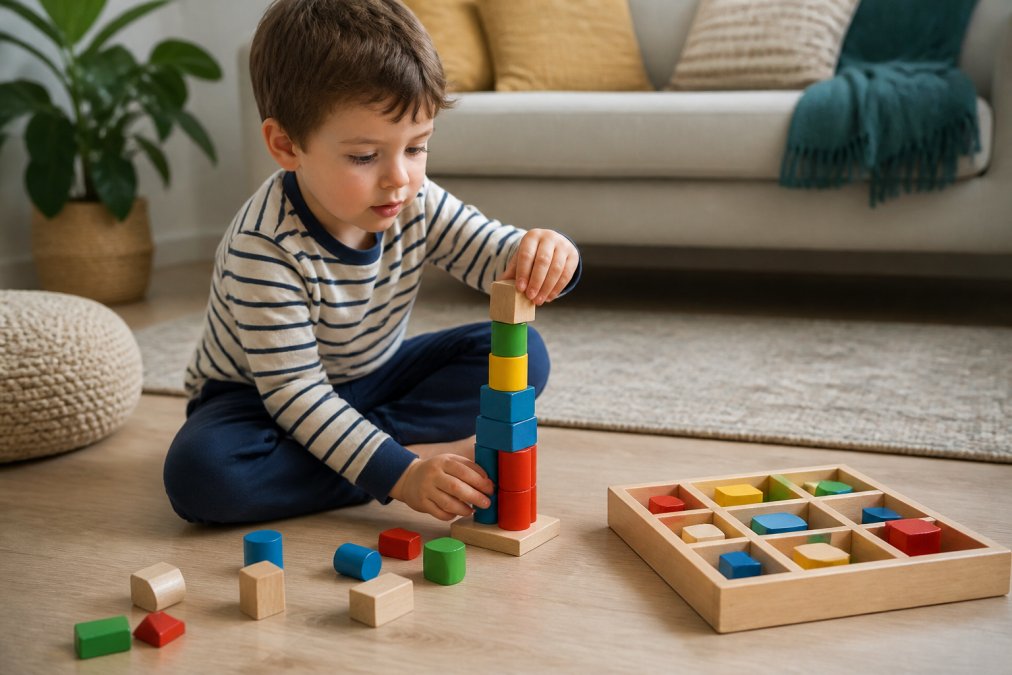
STEM toys for 4 year olds work best when they feel like play, not lessons. The reason is developmental: at four, children learn best through hands-on cause-and-effect, not abstract instruction. A toy that lets a child build, knock down, sort, and rebuild is teaching spatial reasoning, problem-solving, and logical thinking in the only way a preschool brain really absorbs them.
Construction sets and spatial reasoning
Construction play is the clearest entry point into STEM thinking at this age. The mechanism is simple: when a child stacks blocks, the tower falls, and the child adjusts, they are running a real experiment in balance, gravity, and cause and effect. That loop, build, fail, adjust, succeed, is the same problem-solving cycle engineers use.
A few concrete categories worth knowing:
- Wooden unit blocks (the classic rectangular, square, and triangular sets) teach balance and proportion. They are the most open-ended option and tend to stay in rotation for years.
- Magnetic tiles (square and triangular pieces with embedded magnets) let a four-year-old build stable structures without the frustration of pieces that won't stay put. They are especially good for children who get discouraged easily.
- Interlocking brick sets sized for preschoolers introduce the idea of a plan, following a simple picture to reach a result.
- Connecting straws or pipe builders add a flexible, bendy element that pushes spatial thinking in a different direction.
Shape sorting, pattern recognition and number sense
Shape sorters and pattern games introduce early math concepts through the body, not through worksheets. Matching a triangle to a triangle slot is pattern recognition. Counting blocks as they stack is one-to-one correspondence, the understanding that each object gets one number. Sorting by colour, size, or shape is classification, which is a foundation of later algebra and data thinking.
Concrete examples that work well at four:
- Shape-sorting cubes and posting boxes for matching and classification.
- Pattern blocks and pattern cards where a child copies or extends a simple sequence (red, blue, red, blue).
- Counting frames and ten-frames that make quantity visible rather than abstract.
- Simple balance scales where a child compares weights, heavy vs. light, more vs. less.
The play-based learning framework: why these toys work
Rather than asking "is this toy educational?", ask what developmental loop the toy creates. A genuinely educational toy for a four-year-old usually does three things:
- Gives the child control. The child decides what to build, sort, or count. Adult-led instruction is not required.
- Provides immediate feedback. The tower falls, the shape doesn't fit, the pattern breaks, the toy itself tells the child what happened.
- Invites repetition with variation. The same toy can be used a hundred different ways, so the child keeps practicing the same underlying skill without getting bored.
Developmental Benefits of Educational Toys at Age Four
The developmental benefits of educational toys at age four show up across several areas at once. A single good toy often supports motor skills, language, and social play together, which is why matching toys to milestones matters more than buying in bulk. The useful question is not "what does this toy teach?" but "what is this toy letting my child practice?"
Fine motor skills, coordination and tactile learning
Four-year-olds are refining their grip, hand-eye coordination, and control. The mechanism is repetition: every time a child threads a bead, laces a card, or snaps two pieces together, they are strengthening the small muscles in the hand and the hand-eye feedback loop that will later support handwriting.
Concrete toy types that build these skills:
- Lacing cards and threading beads for grip and precision.
- Playdough and clay for hand strength and finger isolation.
- Scissors and cutting activities (safety scissors) for bilateral coordination.
- Pegboards and stacking toys for pincer grasp and control.
Early literacy, phonics and preschool readiness
Alphabet puzzles, letter games, and picture-story sets support early literacy and phonics. The mechanism is familiarity: a child who has played with letter shapes recognizes them faster when reading starts, because the visual form is already stored. The same is true for sound play, rhyming games, silly songs, and alliteration activities build phonological awareness, which is one of the strongest early predictors of reading success.
Concrete examples that work well at four:
- Magnetic letters and letter-matching puzzles for shape recognition.
- Rhyming card games for sound awareness.
- Story sequencing cards for narrative thinking and comprehension.
- Pretend reading with picture books where the child "reads" the pictures.
Social and emotional learning through play
This is the area most toy guides skip, and it matters just as much as academics at four. Turn-taking games, pretend play, and cooperative building all give children practice in waiting, negotiating, and managing frustration. A four-year-old who has played a simple board game has practiced losing gracefully, a skill no worksheet teaches.
Concrete examples:
- Simple turn-taking board games (colour-matching, path games) for patience and rule-following.
- Pretend play sets (kitchens, doctor kits, shops) for empathy and role-taking.
- Cooperative building projects where two children work on one structure.
- Emotion cards and feeling faces for naming and recognizing emotions.
How long should a four-year-old play independently?
Many four-year-olds can play independently for 15 to 30 minutes with a genuinely engaging toy, though this varies widely. Open-ended toys tend to hold attention longer than single-purpose ones, and quiet, low-distraction settings help children stay focused. If a child is bouncing between toys every two minutes, the issue is usually the toy, not the child, a toy that gives the child control and clear feedback will hold attention far longer than one that only does one thing.
How to Choose Toys for Preschoolers Without Wasting Money
Knowing how to choose toys for preschoolers comes down to three filters: developmental fit, durability, and whether the toy will still be interesting in six months. Apply those and you avoid most impulse buys.
Neurodivergent-friendly toy selection
Children with sensory sensitivities or attention differences often do better with toys that offer predictable outcomes, low noise, and clear tactile feedback. Simple building sets, sensory bins, and sorting activities tend to work well. Avoid toys with flashing lights and loud sounds if your child is easily overwhelmed.
Toy longevity, sustainability and budget-conscious DIY play
Wooden toys and classic construction sets often outlast plastic novelty items by years, which makes them a better long-term buy. Sustainability and longevity go hand in hand here. You can also build a strong educational toy collection on a budget with DIY options: homemade sensory bins, cardboard building blocks, and counting games with household objects all deliver real developmental value.
| Toy Category | Key Skill Built | Typical Lifespan | Best For |
|---|---|---|---|
| Wooden blocks | Spatial reasoning, coordination | 3+ years | Open-ended play |
| Shape sorters | Pattern recognition, number sense | 1-2 years | Early math |
| Alphabet puzzles | Phonics, early literacy | 1-2 years | Preschool readiness |
| Sensory bins | Tactile learning, focus | Reusable | Neurodivergent-friendly play |
| Magnetic tiles | Problem-solving, creativity | 3+ years | Independent play |
Screen-Free Play Alternatives That Actually Hold Attention
Screen-free play holds attention when the toy gives the child control and a clear sense of progress. The best screen-free alternatives are hands-on, tactile, and open-ended, which is exactly what keeps a four-year-old engaged without a screen.
- Sensory bins filled with rice, beans, or water and scoops
- Pretend play sets like kitchens, doctor kits, or tool benches
- Simple board games that teach turn-taking and social skills
- Art and craft supplies for imaginative play and fine motor work
- Outdoor exploration kits with magnifying glasses and bug catchers
Frequently Asked Questions
What are some good educational toys for a 4-year-old?
Look for toys that combine hands-on learning with open-ended play: wooden building sets, shape sorters, magnetic tiles, lacing beads, and simple letter and number games. The best educational toys for 4 year olds support fine motor skills, early literacy and problem-solving at the same time, rather than drilling one skill in isolation. Choose items your child can use independently, then add a few that work well for collaborative play with a sibling or parent.
How do educational toys help a 4-year-old's development?
The developmental benefits of educational toys come from repetition and active manipulation. Stacking, sorting and threading build fine motor skills and coordination. Puzzles and pattern games strengthen spatial reasoning and logical thinking. Alphabet and phonics toys prepare children for preschool readiness. Because four-year-olds learn through play rather than instruction, a toy that invites repeated use does more for cognitive development than a worksheet or an app session.
How do I choose toys for preschoolers that won't end up in the donation pile?
Buy fewer, better toys. Prioritise open-ended play items that can become a castle one day and a shop the next, and check that the toy still offers a challenge six months later. Rotate what is on the shelf so old favourites feel new. Sturdy materials and simple designs tend to hold attention longer than toys with one fixed outcome, and they survive the rough handling that comes with active four-year-olds.
Are screen-free toys really better than educational apps for 4-year-olds?
Screen-free play gives four-year-olds something an app cannot: real tactile learning with their hands, plus the social skills that come from playing alongside others. Manipulatives such as blocks, beads and puzzles build coordination and spatial reasoning through physical trial and error. That does not mean screens are useless, but for this age group, hands-on toys generally deliver more durable developmental value per minute of play.