

Educational Toys for Screen-Free Play: 9 Best Options
Table of Contents
- Why Educational Toys for Screen-Free Play Matter
- Benefits of Screen-Free Play for Toddlers
- Best Educational Toys for 4 Year Olds and Older
- Top Educational Toys for Screen-Free Play by Age
- Portable Screen-Free Toys for Travel
- How to Choose Educational Toys That Stick Around
- Sustainable and Budget-Friendly Screen-Free Play Options
- Frequently Asked Questions
Last Updated: September 29, 2026
Why Educational Toys for Screen-Free Play Matter
Screen-free play is more important than ever, which is why educational toys for screen free play matter so much for child development. When children engage with educational toys for screen free play, they develop critical thinking, creativity, and social skills that passive screen time simply cannot build. At Tees and Kids Toys, we understand that parents want toys that actually keep kids engaged while supporting their development, not just occupy them temporarily before ending up in the donation pile.
The difference between a toy that sticks around and one that gets abandoned comes down to one thing: does it challenge the child's mind while keeping their hands busy? Educational toys for screen-free play do exactly that. They encourage independent play, foster problem-solving, and build confidence through hands-on exploration.
Benefits of Screen-Free Play for Toddlers
Screen-free play builds neural pathways that screen time cannot replicate. When toddlers manipulate objects, stack blocks, and solve simple puzzles, they're strengthening fine motor skills, hand-eye coordination, and spatial reasoning simultaneously.
Research consistently shows that hands-on play supports cognitive development in ways that passive consumption does not. Toddlers who engage in constructive play develop better concentration, improved problem-solving abilities, and stronger emotional regulation. They learn to entertain themselves, which builds independence and confidence.
Beyond development, screen-free play creates space for genuine parent-child interaction. When you sit down with your toddler to build with blocks or sort shapes, you're not just playing, you're modeling curiosity and showing your child that learning is joyful. That's something no screen can provide.
Best Educational Toys for 4 Year Olds and Older
By age 4, children are ready for toys that require planning, strategy, and creative thinking. They can follow multi-step instructions, understand cause-and-effect relationships, and engage in imaginative storytelling that lasts for hours.

The best educational toys for 4-year-olds bridge concrete play and abstract thinking. They include building systems that allow kids to design their own creations, STEAM-focused kits that introduce basic science concepts, and games that teach logic and sequencing. At this age, children thrive when they have control over the outcome, toys that offer open-ended play consistently outperform rigid, single-purpose options.
Top Educational Toys for Screen-Free Play by Age
Toys for Babies 6-12 Months
Babies at this age are sensory explorers. They learn through touch, sight, and sound. The best toys for this stage offer tactile variety, bright colors, and simple cause-and-effect interactions.
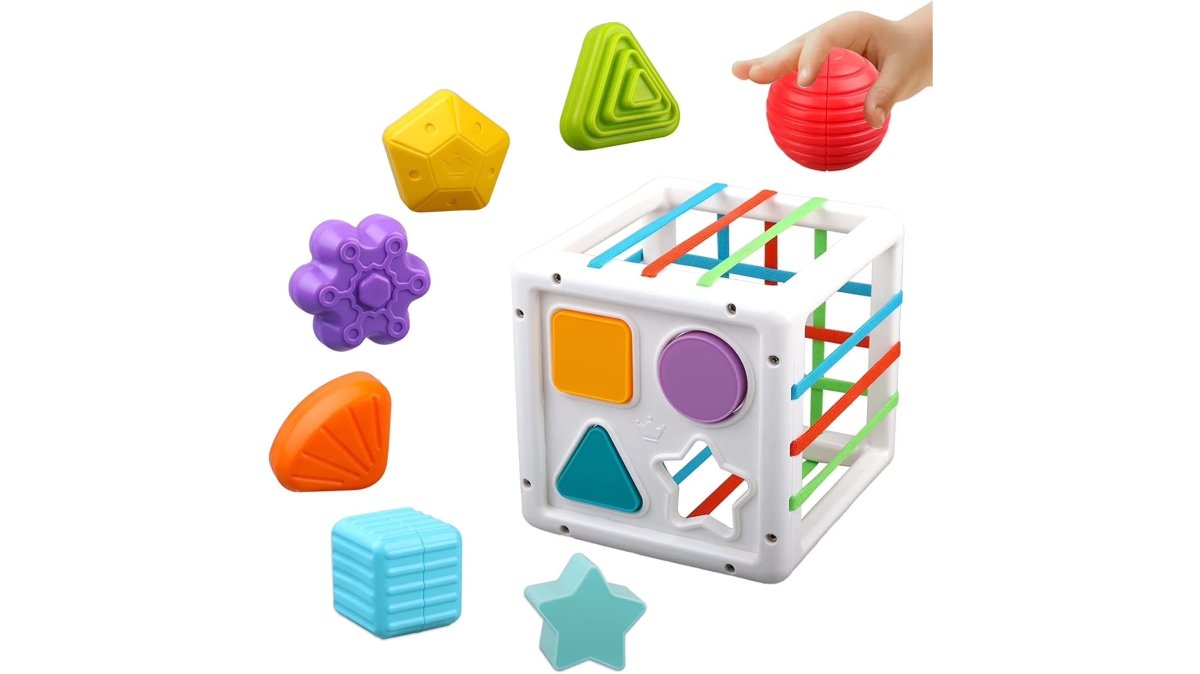
The Baby Toys 6-12 Months, Shape Sorter Blocks Toy from Tees and Kids Toys starts at $30.90 and includes 10 uniquely textured shape blocks. Each block has a different shape, triangle, square, circle, star, and more, designed to develop hand-eye coordination and shape recognition. The soft elastic bands make it safe for gums and hands, and the bright colors stimulate visual development. Babies push shapes through elastic-band openings, which builds fine motor control and sensory awareness.
For slightly older babies (12-18 months), the Baby Montessori Learning Toys for 1 Year Old Boys at $25.22 offers a different approach. The dinosaur-shaped toy has removable spikes in five colors, with numbers 0-9 printed on the back. Babies practice fitting spikes into matching color and number holes, which develops color recognition, number awareness, and finger strength. The self-storing design keeps pieces from getting lost, and the creative dinosaur shape makes it visually interesting.

Both toys support sensory exploration and fine motor development without overstimulation. They're designed for independent play, which gives you a few minutes of uninterrupted time while your baby develops critical skills.
Toys for Toddlers 1-3 Years
Toddlers are ready for toys that combine multiple activities. They benefit from variety because their attention spans are growing but still short. The best toys for this age group offer different ways to play, which keeps engagement high.
The 32PCS 6-12-18 Months Baby 5-In-1 Montessori Toys at $47.81 includes stacking cups, soft stacking rings, building blocks, toy chains, and bath toys. This 32-piece set works as an outdoor toy, water toy, and quiet-time activity. Toddlers can stack cups by size, chain rings together, and build simple structures. The variety means a single toy set provides weeks of engagement across different contexts, home, bath time, outdoor play, and travel.
Baby Toys 6-12 Months, Shape Sorter →
What makes this set stand out: it grows with your child. A 12-month-old stacks cups and explores textures. A 2-year-old builds more complex structures and sorts by color. A 3-year-old uses the blocks for imaginative play. That progression means you're not replacing toys every few months.
Toys for Preschoolers 3-6 Years
Preschoolers are ready for toys that require planning, creativity, and problem-solving. They can follow instructions, understand basic rules, and engage in pretend play that lasts for extended periods. Educational toys for this age group should challenge their thinking while remaining achievable enough to build confidence.
The 5-6Pcs/Set Montessori Wooden Toys at $45.41 offers six different activities in one set: stacking rings, color-sorting clock, sorting puzzle, xylophone with two hammers, bead maze, and twisting toy. Made from high-quality natural wood with water-based paint, each toy develops different skills. The xylophone introduces musical concepts and hearing development. The color-sorting clock teaches sequencing and color recognition. The bead maze develops fine motor control and hand-eye coordination.

For preschoolers focused on STEAM learning, the STEM Explorers Mathlink Builders at $18.61 is a standout value. The 100-piece set of interlocking cubes in 10 colors comes with an activity guide containing challenges. Kids can build animals, objects, and structures while learning early math concepts. The cubes press, pull, and twist together, which develops fine motor skills and critical thinking. Unlike passive building toys, the activity guide provides structure while still allowing open-ended creation.
The Wooden Clock Teaching Time Toy at $42.71 teaches a skill preschoolers genuinely need: telling time. It includes a wooden clock with movable hands, four double-sided flashcards, and a board game for 2-4 players. The game teaches hours, half-hours, and quarter-hours through interactive play. Reusable dry-erase cards let kids practice repeatedly, and the three difficulty levels grow with your child's skills.
Portable Screen-Free Toys for Travel
Travel time doesn't have to mean screen time. The right portable toys keep kids engaged during flights, car rides, and waiting rooms without requiring batteries or subscriptions.
How to Choose Educational Toys That Stick Around
The difference between a toy that gets played with for years and one that ends up in a donation box comes down to a few key factors.
| Selection Criteria | What to Look For | Red Flags |
|---|---|---|
| Design | Multiple ways to play, open-ended | Single purpose, rigid instructions |
| Age Match | Challenges current skills, grows with child | Too easy or too hard for current age |
| Durability | Solid materials, reinforced construction | Cheap plastic, fragile parts |
| Storage | Self-storing or included storage box | Pieces get lost, takes excessive space |
| Educational Value | Develops specific skills (motor, cognitive, sensory) | "Educational" label without clear learning goal |
Sustainable and Budget-Friendly Screen-Free Play Options
Quality educational toys don't require premium pricing. Some of the best values come from Montessori-inspired toys that focus on fundamental skills rather than licensed characters or electronic features.
Frequently Asked Questions
What are the best educational toys for screen-free play that actually keep kids engaged?
Educational toys that combine open-ended play with hands-on learning work best. Shape sorters, building blocks, and Montessori toys develop fine motor skills and cognitive development while keeping children engaged for extended periods. The key is choosing toys that grow with your child, toys like the 5-6Pcs/Set Montessori Wooden Toys ($45.41) offer multiple ways to play, from stacking to sorting to music exploration, so kids return to them repeatedly rather than abandoning them.
How do benefits of screen-free play for toddlers support development?
Screen-free play builds critical developmental skills that screens cannot. Hands-on activities strengthen fine motor skills, spatial reasoning, and problem-solving abilities. Tactile learning through toys with different textures enhances sensory awareness, while imaginative play with construction sets and pretend-play items develops creativity and independent thinking. Research shows children who engage in screen-free play demonstrate better concentration, improved hand-eye coordination, and stronger social skills when interacting with peers.
Which portable screen-free toys for travel are worth packing?
Compact toys with multiple functions work best for travel. The Baby Montessori Learning Toys ($25.22) with its self-storing design fits easily in a bag, while the STEM Explorers Mathlink Builders ($18.61) offers 100 pieces in a manageable set. Bath toys like the Lotfancy Bath Toy, 8PCS Mold Free Bath Toys for Kids Ages ($23.55) are lightweight and serve double duty during hotel visits. Choose toys that don't require batteries or external pieces, self-contained options prevent lost parts and frustration on the go.
Are educational toys really better than cheaper alternatives, or is it just marketing?
Quality educational toys deliver measurable developmental benefits. Toys designed with Montessori principles or STEAM focus incorporate specific features, like varied textures, colour recognition elements, and problem-solving challenges, that generic toys skip. The Interactive Kids Kitchen Playset with Cookware Accessories - Sound & Lights for Endless Fun ($157.38) teaches imaginative storytelling and social skills through pretend play with realistic features, while cheaper alternatives often lack the durability or educational structure that keeps children engaged long-term. Investing in quality toys reduces replacement costs and frustration.
How do I know if a toy will actually develop my child's skills?
Look for toys that target specific developmental milestones. Shape sorters build hand-eye coordination and colour recognition for babies 6-12 months. Wooden puzzles and construction sets develop spatial reasoning and fine motor skills for toddlers 1-3 years. STEAM toys like Mathlink Cubes introduce logical thinking and critical problem-solving for ages 5+. Check the product descriptions for which skills each toy addresses, genuine educational toys explicitly state their developmental benefits rather than just claiming to be 'fun.'